Wednesday, January 26, 2011

More on Reading the Best

Here’s another way of unearthing some of the best books published, ones that will help you irrigate and fertilize your inner landscape: check out the major award winning books over the past years.


While I don’t for one moment suggest that only prize winners are worthy of reading, or that superb books don’t get overlooked for prizes, it is a reliable place to start. And it’s a great way to discover writers whose work is unique and invigorating, writers who may well become your favourites.


So here are some sites to check:


The Governor General’s Literary Award Winners from 1936 to 2010


NOTE: Children’s Literature was not included in these awards until 1987


The Newbury Award winners, from 1922 to present


Lately, there has been some discussion as to whether the Newbury Award winners appeal sufficiently to children, or whether they’re overly slanted to adult tastes. I happen to disagree – I find the winners consistently excellent and eminently readable. Not all award winning books go on to become best-sellers and I believe that awards should focus on the best, not just the most likely to be popular books.

– There are several children’s literature prizes in the UK and I find these winners are always of a quality, and splendid reads.


Happy reading, and may you discover new treasures.

Wednesday, January 19, 2011

Some Book Recommendations

It's mid-way through January, and I suspect many a resolution has already been broken if not actually forgotten. At the beginning of the year, I like to think on the books I will read, anticipate the oodles of time I will have to indulge in the delight of losing myself between the pages of books. And reflect back on the books I read last year, often with some haziness because I tend not to have a very good memory -- perhaps because I prefer to read for the sheer pleasure of it, than to analyze.

About a year and a half ago, though, frustrated with my inability to remember which books I'd read -- or what they were about if I had read them -- I began to compile lists of books I'd read. I put them in two categories: ones I'd recommend and the ones I wouldn't. I wrote a brief description of each book, along with what I found particularly compelling (or not) -- which is a useful thing for a writer to do because it serves as a source of reference if I want to study a book to see how a particular situation, say point of view, or multiple narratives, was handled in a book that I deemed to be a success.

I won't go into the books I wouldn't recommend -- I don't see the point of it. I know how writers pour their hearts out into their work and it doesn't serve any purpose to include here a list of books that I thought were not well written (enough), or books that, although fairly well written, didn't delight me enough to be included in my list of recommendations.

Every writer I know reads a lot. One of the more delightful things about being a writer is that you learn through the sheer joy of reading, even when you don't know you are learning. It serves both the art and the craft of writing to simply read, read, read.

It helps, though, to read the best of writing so the subconscious mind isn't filled with reams of mediocrity. I think the mind tends to burp it up, if that is all you read.

So here is a list of just a few of the books I read recently that I'd recommend. This isn't a comprehensive list of all the books I read, let alone all of the ones on my recommended list; nor are they all recent publications. But these are books I enjoyed for a number of reasons -- some because of the brilliance of the writing, some because of the inventiveness of the plot, or striking voice, but all because they satisfied at a certain level. I haven't included the books I've already mentioned in previous blog postings. Most of these are children's books -- I read all over the place, adult fiction as well as children's fiction -- but I won't indicate which is which, because a good children's book is ageless. So, in no particular order:

Counting Stars by David Almond

Jackdaw Summer by David Almond

The Mistress of Nothing by Kate Pullinger

Harriet the Spy by Louise Fitzhugh

Alice, I Think by Susan Juby

Nation by Terry Pratchett

The Knife of Never Letting Go by Patrick Ness

The Hunger Games Trilogy by Suzanne Collins

A Thousand Shades of Blue by Robin Stevenson

Cockroach by Rawi Hage

Bog Child by Siobhan Dowd

Bones of Faerie by Janni Lee Simner

Something to Hang Onto by Beverley Brenna

The Gathering by Anne Enright

I, Coriander by Sally Gardner

Saffy's Angel
Indigo's Star
Permanent Rose by Hilary McKay
Caddy Ever After
Forever Rose

The Peppermint Pig by Nina Bawden
Granny The Pag
Carrie's War

Friday, December 31, 2010

END OF YEAR REFLECTIONS -- ON REFILLING THE BURP POT

It's just another day, really, the last day of the year, and yet, because there is the ritual of changing calendars, it's an opportunity to reflect on the past year, come up with plans for the new year, and generally jerk out of the often automatic frenzied mode in which we seem to live much of the rest of the year.

So, when I think back to my writing this past year, I see all the books I was dying to write at the beginning of the year, but that I didn't get to. Yet.

Oh, if only I could be more efficient, the lament goes. If I were more efficient, my mind would pop from one idea to the next, with freshness and vigor and I'd have written more. It's inevitable, the self-flagellation. The regret.

And yet, there is the other side. That writing isn't a nine to five job. Stories take the time they take. Sometimes years of putting away before they fall into place. Several of my books have lain fallow as it were, for years, before coming to ripeness and publication.

And people write differently. The challenge is to find the way you write best, the way that works for you, and to make peace with it.

For instance, I know writers who are prolific, and they write in a way that is seemingly chaotic to me, with forays into multiple stories simultaneously.

But I can't do that. If I try and force a style of writing that isn't right for me, it's mind-splitting and ultimately, a waste of time.

For me it's important to take time to replenish the burp pot. Yup, burp pot. As in burp pot of ideas.

I sort of have this image of ideas simmering below the conscious mind, in a huge pot. And as you stir -- and often even when you don't -- ideas burp up.

That pot is filled with a stew of life experiences, the people you know, the books you've read, the things you've dreamed and done, your travels...

And sometimes, you just need to take time out to live. It all feeds that pot. Sooner or later, that mish-mash of life will burp up new ideas, fabulous ideas -- that is, fabulous to you ideas that you must write about.

So, my end of year reflection, while still tinged with regret for the books that didn't get written yet, also includes an acceptance that some stories take time, and that all the time I spent not writing was still feeding that pot.

Excuse me while I burp.

Friday, December 17, 2010

Second Draft Blues

Ah, that painful process, where the euphoria of completing that first draft is swiftly replaced with loathing, fear and disgust as you re-read your peerless manuscript and discover it ain't so peerless after all. That it's more full of holes than swiss cheese.

Stinkier than limburger cheese or rotting gorgonzola, and twice as ugly.

A word of advice: relax. Accept that this is the process. It's a long, slow spiral of many drafts before you get to the heart of the last draft.

To use another image, writing fiction is a labyrinthine process, full of dead ends, sudden turns, obstacles and wrong turnings.

You can, as I often do, waste energy berating yourself with gems like, "If I were a better writer I'd get it righter first time around!"

I don't know any writer who does get it right first time around.

It takes the maze-like twists and turns to discover and uncover the story you want to write. It is all part of the process, so relax and enjoy it. It's absolutely necessary to take those wrong turns in order to find the right ones.

Often, that first draft is just scaffolding. Necessary to tear down, but absolutely crucial to build the stunning structure you will end up with.

Enjoy.

Friday, December 10, 2010

Book Recommendation on Writing Fiction

From my posts below about debunking writing myths, it probably won't come as a surprise to hear that I haven't, by any means, read all the books ever written about the process of writing.

The best way to learn about writing, I think, is to just get on with it and write.

Oh, you need to read, of course; you learn from reading wonderful writers. That's a given.

But if you spend too much time studying writing, it can stymie your natural voice and natural skills and make you an imitator. Or trip you with too many theories and not enough practise. Or ensnare you in the convoluted business of studying writing instead of getting on with it. (I'm up on every procrastinatory technique, believe me!)

That said, here is an excellent book about the process of writing fiction. It discusses setting, character, plot, point of view, the shapes of a story, the process of editing, and much more.

I have a copy and when I get stuck over some writerly matter, this is my go-to book:

A PASSION FOR NARRATIVE by Jack Hodgins.

It is clear, insightful and comprehensive.

Thursday, December 2, 2010

Debunking Some Writing Myths 3

Here's another piece of advice writing teachers tend to hand out: always do a story outline before you write.

To which I say -- maybe.

Maybe you're the kind of writer for whom this is necessary; maybe this is the kind of story with so many convoluted and intersecting plotlines that you need an outline to keep things clear in your own head.

But maybe you'll find that making a story outline destroys any interest you have in writing the story. That an outline corsets your characters and prevents them from taking on life and leading the story in a direction that you'd never, ever planned, and yet is SO right.

If you do decide to make a plan or story outline, it is crucial to understand that it is just a guide and that it must never be followed slavishly.

I've written novels for which I've never done a story outline (not on paper, anyway -- although I always have a sense in my head of the arc of the story and how the tension must build) and ones where I've done fairly detailed outlines.

When writing fantasy or mystery, I've found a general outline useful because it's a way for me to keep interweaving plots, and the motives behind all my various characters' actions straight. (Yes, if the story is to make sense, every character must have a believable motive for his/her actions.)

I've also found an outline useful as a way to try and capture the feel or atmosphere of the story once I think I have it right. Usually, I will go for a walk (many walks, actually!) to pound out ideas, and to try and move the trajectory of the story forward in my head. Then I jot down notes -- snippets of ideas and snatches of dialogue as they come to me. Once I feel that I have all the pieces, and that they fit, and I have a sense of the atmosphere and the voice of the story, I may write an outline, just for the relief of knowing I have that as a reference in case I forget a small piece of motivation, or plot detail, or some such thing.

But inevitably, I have found that once I start to write the story will go off on a trajectory that I hadn't planned -- but that is right. Well, right enough for that draft, anyway.

Some writing teachers suggest making a chapter by chapter outline. Some writers I know do this.

You have to find what works best for you. I couldn't bear to do a chapter by chapter outline because it would bore me to death to write the story. I like to discover and explore as I write and if I have every event and detail pinned down in the outline, I think I'd find it a slog to actually write the story. I'd just lose interest in it. But that's me.

To outline or not is something each writer must decide for her/himself. It may even vary from story to story.

Monday, November 22, 2010

Debunking Some Writing Myths 2

Here's a rule that writers taking courses are often told: Write about what you know.

To which I say, rubbish. Write about what you want to write about, what you're passionately curious about. Then do the necessary research. I have little interest in writing about what I know, because, well, why bother? Writing is very much a process of exploration for me and I don't have much interest in writing solely about what I know because there is no heat of the chase, nothing to discover and uncover.

Take my most recent novel THE TROUBLE WITH DILLY, for example.


It's about a girl, Dilly -- wildly imaginative, exuberant and impulsive -- who lives with her family in a large Canadian city above their family grocery and Indian food take out, and who plays hockey. I've always wanted to write about a girl who played hockey, but I don't know (or rather, didn't know) much about it. Nor did I know anyone who runs a grocery store.

So I did my research. I visited corner grocery stores in a variety of places to try and get the feel of them, to get Dilly's family store right, a sense of the layout and items they'd stock. The atmosphere and pulse.

I also spoke to family, friends and neighbours who knew about hockey, followed hockey games on TV and even went to local Pee Wee hockey game, and met up with the coach and a few girls who played in the team, to hear their stories and viewpoints. It was a huge amount of fun, and a wonderful glimpse into the hockey culture.

I also had to research Christmas customs in Hungary, immigration challenges for new immigrants, some aspects of Chinese culture, and much more.

It was all part of the fun, part of widening my view of life and expanding my horizons of interest.

I like to think this story is a quintessentially Canadian Christmas story, celebrating as it does cultural diversity and hockey.

But it would never have been written if I stuck only to what I know. For that matter, nor would most of the other books I've written.

Friday, November 12, 2010

Debunking Some Writing Myths 1

A writer starting out is often looking for a set of rules to follow -- ones that will teach him/her everything she/he has ever wanted or needed to know about writing, and that will guarantee success, fame and fortune.

And of course, there are courses and books a-plenty with lists of rules about writing.

Here's the rule with which I start all my creative writing workshops:

There are no Golden Rules.

Each writer must find and discover her/his own unique approach to writing, find out what works for her/him.

You can learn the craft of writing -- well, aspects of it, anyway -- but no one can teach you the art of writing. You learn that by writing, by trial and error and finding out what works for you.

Friday, November 5, 2010

Finding the Right Voice -- Don't Show Off

Part of good story-telling is finding the right voice to fit the story. Here's something to bear in mind: please let the language and words serve the story, not the other way around. Don't slaughter story at the altar of your writerly ego. (Oh, I know, it's tempting!)

For me, the best books are where the writer is invisible. Where I'm caught in the story, where wonderful phrases, if there are any, are absolutely integral and true to the story. Where the author isn't pirouetting around with flash phrases that stick out like a sore thumb, shrieking, "Look at me, look at me!" Or leaping about with grandiose phrases, no matter how lovely, with a cheesy, "Look, aren't I clever?"

Beautiful language can only take you so far. After a while, the reader's admiration can ebb into frustration and even downright hostility because instead of engaging with the story, the language sticks out its knobbly feet and demands attention and homage to the author. Perhaps in an attempt to divert attention from the lack of story?

So, don't show off. Let the tale flow, let the tale do its part.

This is not to say that beautiful language is not appropriate at times. But it needs to serve the story, it always needs to serve the story, not the other way around.

So...

Desert the delectable phrases

Eschew the urge to pontificate, with or without marbles in your mouth, no matter how stunning the marbles.

Say it plain.

Say it clear.

Saturday, October 30, 2010

Writing In The First Person -- Some Common Pitfalls

I've always loved writing in the first person because it forces me to get inside my character's heart, head and soul and to explore and delve into her/him and then become her/him.

But to write convincingly in the first person, you need to uncover and discover that character's voice -- come up with a voice that is fresh, distinctive and completely convincing.

Here are some common pitfalls I've noticed in books written in the first person:

-- having a generic voice. This might work in a third person narrative (well, only maybe, because let's face it, generic is blah, no matter what point of view you chose to write in) but it is particularly grating in a first person narrative. If it doesn't work and the voice is unconvincing, the book will fail to engage the reader even if the story is exciting.

-- tied to the generic voice is the lack of anything distinctive to make the character's voice singular. If you can't tell who is speaking without saying so, perhaps the voice isn't distinctive enough. And perhaps that points to a deeper problem -- maybe your character isn't distinctive enough. Maybe you don't know enough about your character to write convincingly from his/her point of view.

-- in writing for children, having a voice that is too old. Adults can often have trouble connecting with the child's inner vocabulary and intensity, and the rhythms of speech and thought.

-- using vocabulary that is too old for a child narrator.

-- using expressions that are too old for a child narrator. (Warning here: yes, kids today say "like" almost incessantly, but if you use it in a story the way a kid might in real life, it'll trip the reader and mask the story. The trick is to use it sufficiently to make the voice sound like a kid's voice, but not enough to annoy the reader.)

-- getting the rhythm and pacing wrong when writing from a child's point of view

-- getting the rhythm and pacing wrong for a first person narrative. A first person narrative has to sound like a person telling the story (aside: you can use a first person point of view to have the narrator tell someone else's story, not their own) and as such has to reflect the rhythms of that particular person's voice.

Sometimes it takes many rounds of edits to get that voice right. In the early drafts of my first children's novel, A FRIEND LIKE ZILLA I found myself writing in a voice that was distant -- it sounded like an adult looking back and remembering. I had a superb editor, Charis Wahl, who pointed this out. It took many re-writes to get that voice right, to make the voice of the main character, Nobby, ring true, and seem convincing and particular to her.

Some books are like that. Part of finding Nobby's voice and making it convincing, was getting to know Nobby and making her convincing.

And then there are books where the voice just comes to you. When that happens it's a gift. It happened with my picture book A Screaming Kind of Day. Scully was real to me from the get go. I had her voice clear in my head from the get go.

But regardless of whether the voice of your character is clear from the start or not, it's imperative, if writing in the first person, to make it convincing and unique and true to the character.

Friday, October 22, 2010

Creative Cross-Fertilization Part 2

Following on my previous post on creative cross fertilization and specifically, the inspiration of music, here are some thoughts for writers: Try writing to music. See what it does for you. Try listening to a variety of music and see what best suits your story. Will your story change, or does your writing style change with different types of music? Is it different if you listen to classical as opposed to rock, or heavy metal, or folk, or blues, or blue grass? Here’s another thought: What is your character’s favourite music? Figuring it out offers a sideways glimpse into your character to flesh him/her out in a way that perhaps mere biographical details can’t. This might never show up in your writing, but you’ll know that detail about your character, and it’ll inform your writing. And what kind of music does your character hate? This too tells you something about her/him. Oh, and try this – if your character were a piece of music, which one would it be? When I started to ponder that, I decided that Dilly, in The Trouble With Dilly, would be Mozart’s Eine Kleine Nachtmusik, or perhaps Bach’s Third Brandenburg Concerto. Oh, both are my favourites! Red – a character with whom I’ve spent a great deal of time lately, as I’ve re-worked THAT BOY RED – might, I think, be Beethoven’s Pastoral. Or perhaps some East coast fiddle music. What music best represents your character?

Friday, October 15, 2010

Creative Cross-Fertilization

Recently, I attended a concert at the Shenkman Arts Centre in Orleans, performed by the chamber orchestra I Musici de Montreal, founded and conducted by Yuli Turovsky. They played some Mozart to start, and then the work of a composer I’d never heard of before – Modest Moussorgsky, called Pictures at an Exhibition, but with a twist. The screen above the musicians, showed an animated version of the art of Viktor Hartmann, a friend of the composer. It was Hartmann’s art that inspired Moussorgsky to write the music he did.

In the performance I attended, the art and the music came together, with the art cleverly reinterpreted with surrealistic flow and movement (animated, if you like) by the composer’s daughter.

I love the idea of art inspiring music which in turn inspired the flowing animation of the art we saw, all of which inspired me to write this entry in this blog.

It reminded me that any form of art inspires and stirs creativity. That exposure to other artistic mediums can enrich, inform, and enhance our own.

For example, when I was writing my picture book story, Roses for Gita, (a sequel to my picture book Lights for Gita) a crucial, and I think magical, scene in the story fell into place during a Suzuki violin concert in which my daughter was playing. The inward expressions of the kids as they made beautiful music together made me suddenly realize that music is a language of its own, and that a difficult character in the story Roses for Gita, Mr. Flinch, might just be reached through music. I had an image of him, this grumpy, cantankerous old man, playing the violin, his face inward and absorbed with the music, caught in its delight.

That image sent a chill through me and I knew it was right for the book.

In my next post on Oct 22th, I'll suggest some ways in which you can use music to enhance your writing as well as find out more about your characters.

Saturday, October 9, 2010

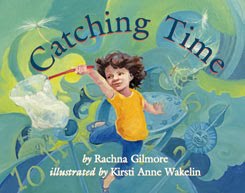
The New Grown Up -- Catching Time


Here it is, the cover of the newly arrived as a grown-up book, CATCHING TIME. Illustrated by the wonderful Kirsti Anne Wakelin. I've just figured out how to put pictures on this blog, and I had to show off Kirsti's fine work. I love the whimsy of Kirsti's art, the energy and movement.
It perfectly echoes the hurry and bustle of trying to catch time.

Thursday, October 7, 2010

A New Book Is Born -- Or Rather, Grown Up

I'm delighted to announce the birth of a new book. My picture book, CATCHING TIME illustrated by the wonderful Kirsti Anne Wakelin published by Red Deer Press/Fitzhenry & Whiteside.

The process of creation is an interesting and circuitous one -- there's the initial euphoria of creation, the doubt and loathing of the various and multitudinous stages of editing, the inevitable putting away...

This book was started in the nineties, fiddled with endlessly, forgotten, then rediscovered.

When I rediscovered it, I found that I loved the concept but that the story didn't work because the VOICE wasn't right. (I've posted before about the importance of voice.) It wasn't the voice of a child, and as such it didn't echo and resonate with the emotional core of a child.

Once I re-wrote the story in a real child's voice, it quickly found a home.

Perhaps it's curious -- or not -- that this story, about catching time, should have taken so much time to come to fruition. Time, that wily old trickster, at play again.

After the story was accepted by Red Deer Press, it still went through endless fiddling and editing, (I was fortunate to work with Peter Carver, a wonderful editor) repeated reading aloud to taste the ebb and flow of the words, before it was ready for print.

By that point, the book felt like a surly teenager I couldn't wait to see the last of.

And then...and then, the book comes back, all bound and printed, and suddenly it's like the surly teenager has grown up.

So a new book is born -- now as a grown up.

Thursday, September 23, 2010

Brave Words To The New Writer

Steven Heighton's post, A FEW MEMOS TO MYSELF is filled with sage, insightful, and tough advice to a writer starting out. It's something to read through periodically if you're new to writing, or if you're established -- maybe even particularly so if you're established -- to avoid the pitfalls of becoming, as he puts it, a careerist writer. I particularly relate to his advice on embracing oblivion. It ties into my previous post on how to keep the joy of writing alive.

It's a hard-headed common sense list to help you keep it real. Be tough on yourself. Be willing to take chances. Insist on taking chances. It's the only way to grow with your writing, for your writing to grow, and to safeguard and nurture your internal creative fires.

Monday, September 20, 2010

More on Writing With Joy

When I first started writing, it was pure -- an acceptance of my lowly early apprenticeship status, an acceptance of how little I knew about writing, and a fluttering hope of being published but not expecting anything.

Now, twenty or more books later, in as many years -- oh, and a few awards and accolades too -- that pure state is harder to find.

My fault. It's when I get bogged down with outcomes, that the joy stalls. Bogged with thoughts of the publishing process (where to submit, etc), hopes for the success (big success -- hey, who dreams of failure, or even mediocre success?) of the novel or picture book, thoughts about the business side of writing and how to best get that book out there.

It's what I've heard the poet and author, Steven Heighton, refer to the secretarial side of writing, versus the sacramental side of writing.

There is a purity to the beginner mind -- it's more open to possibilities. It's less invested in measuring output against time, more open to exploration. That's where the joy is for me.

I need to periodically remind myself of that, even while I accept that the inevitable consequence of being an established author (ha! me established? I so don't feel it, even though that's how I'm regarded) is that the business side of things will keep intruding.

It's finding that balance. Not checking e-mail incessantly (who me?), not getting ensnared and entangled and lost in the countless distractions of the internet, or promotion.

Writing for the joy of it. Pure and simple. Sigh.

Friday, September 17, 2010

Round and Round It Goes

Aaaaak! Round and round it goes, where it stops nobody knows. That's the process of writing. It's a long, slow spiral to the heart of the final draft and boy, it is painful at times. Right now I'm going through another draft -- umpteenth -- of THAT BOY RED my upcoming children's novel for ages 8 and up, due to be released by HarperCollins Canada in April 2011.

It's been a joy, mostly, discovering/uncovering Red's world and the people in it. I've enjoyed reading it as I re-worked it, enjoyed being in his world, which is rural PEI during the Depression. I've enjoyed researching, fine tuning, expanding on characters, inserting the kinds of details that make the story seem to grow and continue beyond the pages of the book.

All requiring focus but for the most part thoroughly satisfying.

But.

Now.

Oh, now, I'm doing what is absolutely essential -- I'm reading it out loud.

And aaaaak!!!!!

I can't believe how the flow stumbles and fumbles in places. This is the stage where I feel frustrated, embarrassed and convinced I'm a crappy, crappy writer. Surely if I could write better I wouldn't find so many places where the language stalls, where the music of the sentences jar and clash instead of flow. Where the cadence flops and drags instead of swooping with ease.

Aaaaaak!!!!!!

It is completely necessary, this stage, to fine tune any piece of writing, because the ear picks up what the eye doesn't.

It is time consuming.

Thoroughly humbling.

And completely necessary.

Wednesday, September 15, 2010

Writing With Joy

Contradictions are the spice of life, so here it is, something contradictory to the last post about opening a vein to write.

Sometimes it is like that, but I don't usually or even often wallow in writerly angst. If I did I wouldn't bother to write. Who needs the anguish?

I'd rather write for the joy of it. The sheer delight of discovering/uncovering story, the thrill of the chase, the joy of spending time with characters you love.

So what about the previous post? There are times you need to open a vein to write. It depends on what you're writing. Opening a vein to write is more about digging deep and not being afraid to explore the painful side of life, even when it's buried deep in you. And I do believe that if your stories are to ring true, you need tears when warranted. I weep when I write parts of my stories; they need to touch me if they are to touch the reader.

Tuesday, September 14, 2010

Opening a Vein To Write

There's nothing to writing. All you do is sit down at a typewriter and open a vein. ~Walter Wellesley "Red" Smith

So true.

In a similar same vein (ha! ha!) Robert Frost said: "No tears in the writer, no tears in the reader. No surprise in the writer, no surprise in the reader."

Sunday, September 5, 2010

A New Idea Is Delicate

A new idea is delicate. It can be killed by a sneer or a yawn; it can be stabbed to death by a quip and worried to death by a frown on the right man's brow -- Charlie Brower

I rarely share a new idea for a novel or even a picture book, until I've written the first draft. The delight of nurturing a new story, the excitement of discovery, the burning lust for what comes next, is for me somehow quenched if I talk about it. For me, writing is a process of discovery. If I talk about it too much, I don't want to write about it. I lose interest.

Not everyone works this way. You need to know what works best for you. I jot down ideas as they come, walk and walk and walk to pound them out (oh, and walk and walk and walk as I write, too, during and in-between drafts) but I don't want the enthusiasm for my fledgling ideas, that to me seem so exciting, so desirous of pursuit, to be flattened by indifference, or crushed or overwhelmed by input from others, however well intended. It's only when I have a fair idea of what I want that idea to be, of how it will grow (of course, that's not to say it doesn't veer off in strange directions once I start to write) that I can even begin to tentatively share those ideas with others.